The Lost Future of Suikoden: Why Suikoden VI Never Happened12 min read
What actually happened behind the scenes before, between and after the discontinuation of the series?
 
AmethystADV is here to tell you how this series almost came to a grinding halt.

Unlike many RPG series that focus on a single hero, world or conflict, Suikoden created something much larger than that. Every game introduces new nations, new political conflicts, and hundreds of characters. Combined with a dynamic world where everything is moving constantly, every story is part of a much larger history.


This series is never about just defeating the enemy. It’s about rebuilding, bringing people together. And seeing how individual choices can influence the future of an entire world.


That is what made this disappearance so unusual. What actually led up to the discontinuation?


After the release of Suikoden V in 2006, many fans expected it to continue.
This instalment was seen by many as a return to the strengths of the original titles. It combined political storytelling with the emotional range of family relations, betrayal and love, resembling Suikoden II.


But despite the new appreciation for this series, Suikoden VI never arrived.


The question is: What will be the future of Suikoden?


The answer is that they didn’t ran out of stories to tell.

The reason is that the gaming industry changed and Konami’s priorities with it.

Suikoden V Was The Revival, Not The Conclusion

The previous entry, Suikoden IV, had received a very mixed reception compared to earlier games. Longtime fans felt that the series had lost the character development and storytelling focus that made Suikoden II and III stand out.


Suikoden V was the attempt to correct that direction, as it returned to many beloved elements.


We return to a politically driven storyline, a conflict between nations, a castle headquarters that grew throughout the adventure, and more complex conflicts rather than simple good versus evil.


Instead of pushing into another completely new direction, Suikoden V looked back at what had made the franchise successful.


It was a statement of what Suikoden is supposed to be.


The response from many of the fans reflected that. Though the problem is that it did not become a major commercial success on the level of the biggest JRPG franchises. It did restore confidence among parts of the fan base that it still had a place in the RPG landscape.


However, the industry around gaming was already changing.

The Changing JRPG Market in the Mid-2000’s


To understand why the Suikoden franchise disappeared, it is important to understand the gaming environment in which it existed.


The PlayStation era had been extremely successful for traditional Japanese RPGs.


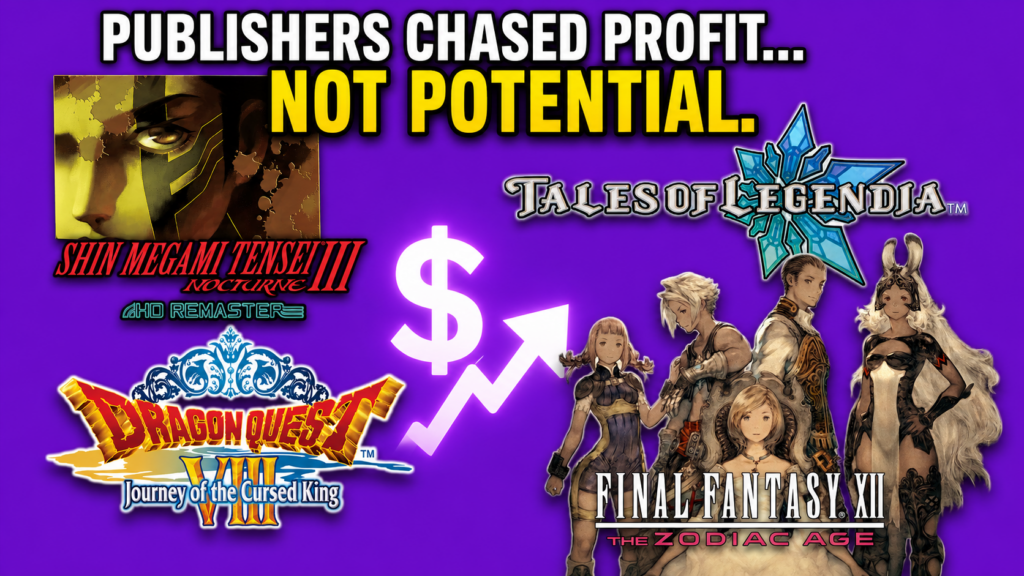
It had great selling series like Final Fantasy, Dragon Quest, the Tales of series, and Shin Megami Tensei.


All of these series have built dedicated audiences around a long single player experience. As mentioned before, by the mid-2000s game development was becoming more and more expensive.


Higher production values were deemed wanted by the audiences and thus that meant larger budgets needed to meet the expectations.
International releases therefore became more important than just being a Japan-only release.


Publishers of games increasingly look for franchises that could justify those bigger investments. Traditional turn-based RPGs faced a difficult transition because of it.


The market was moving more towards action-based combat systems and online experience, portable gaming and eventually mobile gaming.


A franchise like the Suikoden series depended heavily on the things that made it unique.


A large amount of written dialogue, a huge cast, complex political storytelling and interconnected games in their own universe.

For a publisher, continuing a series like the Suikoden series required confidence that the audience would be large enough to support the new investments.


With the mixed reception of Suikoden IV and the underperforming Suikoden V in sales globally, this meant that publishers had their doubts for a new one.

Konami’s Changing Business Direction

The decline of the series cannot be separated from the larger changes happening at Konami itself.


During the years that followed Suikoden V, Konami increasingly shifted its focus towards other areas of entertainment and gaming.


It particularly shifted to digital services, mobile games and casino games. Konami became less focused on producing a large number of traditional console releases compared to previous generations of consoles.


This was not a standalone Suikoden problem. The company was reassessing what types of games fit its future strategy. And unfortunately, for Suikoden this created a difficult situation.


The series was not built around yearly releases or updates. Nor was it designed with a competitive multiplayer product in mind.


It did not fit the emerging and ever-growing mobile gaming model either. Its appeal comes from carefully crafted worlds and long form storytelling.


Those qualities are valuable to players, but they are also expensive to produce with new design techniques and gaming engine capabilities.


Furthermore, the player base always demands better and more.


Why Suikoden VI Never Happened

A big misconception surrounding the disappearance of this series is that it ended because there were no ideas left.

I have covered this before in other Suikoden articles, that there are way more stories to tell.

We could have gone to the Nagarea Theocracy or the Armes Kingdom, or the Holy Kingdom of Harmonia. To the lands surrounding the Island Nations Federation on the west.


The Suikoden universe had plenty of room still to expand.


The games had already established multiple nations, different historical periods and unexplored regions. The foundation was already there.


But a successful franchise requires more than just a fictional universe. It requires development resources, marketing support, publisher investments and money, and confidence in its commercial success.


The originally missing Suikoden VI appears to be connected less to the creative limitations, but more to the changing priorities of the publisher.


Without the interests of the developer and the cash of the publisher, Suikoden was stopped in its tracks.


The future existed, but the business environment to create that future did not exist.
The Franchise Continued, But Changed Direction

The mainline series stopped, but Konami did not completely abandon the series just yet.

It continued through different approaches, way different approaches.


One example was the release on the Nintendo DS in 2008 called Suikoden Tierkreis.

Rather than continuing the original timeline, it introduced a new world with new characters and a separate storyline.


Later on, in 2012, Genso Suikoden: Web of the Woven Centuries was released in Japan only on PlayStation Portable.

This game also explored a different setting rather than continuing the original numbered entries.


The releases show that Konami still recognised the value of Suikoden brand.
However, it also demonstrated that the franchise was moving away from the identity that had originally built its audience.


The question shifted from: “How do we continue the Suikoden series?” to “How can we continue Suikoden in a changing market?”


The Suikoden Name Survived Because The Philosophy Survived

The original series entered a period of silence, but the ideas behind it never disappeared.
The franchise had always represented something different from many other series.

Unlike many other franchises, the player doesn’t simply save the world alone by playing the main character.

The players are always building something in the world around them.


Because of the 108 Stars of Destiny in each game, this represents this philosophy perfectly.

Characters are not just party members who exist to support the protagonist.
They represent soldiers, merchants, strategists, craftsmen and just ordinary people who want to help the larger cause.

This approach created a feeling that the player was building a society rather than just simply completing the game.

That identity has become one of the reasons which have maintained such a loyal fan base even after the new releases stopped.

The Rise Of Spiritual Successors

The strongest indication that the interest in Suikoden has never disappeared comes from the creation of its spiritual successor.


In 2020, the former Suikoden creator Yoshitaka Murayama and several other developers who had worked on the series announced a new game. This one being called Eiyuden Chronicle: Hundred Heroes.


It gained immediate attention because it promised to revisit many of the design philosophies that made the Suikoden series popular.


A large recruitable roster, turn based combat, political storytelling, HQ development, and a world affected by its conflict.


The Kickstarter campaign has become one of the most successful video game crowdfunding campaigns at that time. It demonstrated that there was still a significant demand for this style of RPG.


It also started an important moment. It showed that the problem was not that the players no longer wanted games like Suikoden.


The audience was still there, but the market around the traditional development had simply changed.


What Eiyuden Chronicle Proved About Suikoden’s Future

The success of the Kickstarter had provided an interesting contrast.


A major publisher had moved away from continuing the Suikoden series. But a community driven project built around a similar idea base attracted enormous attention.


This highlighted that the value was never only the name. The value was the design philosophy.


Fans were not asking for another game with the same logo, but they wanted the experience that the franchise represented.


They wanted to be in a world that felt larger than the protagonist and where characters felt like they belonged to a cause.

They wanted political conflicts instead of good versus evil and the feeling of building something from absolutely nothing.


Those are the elements that have remained appealing even years after the original Suikoden games disappeared.

The Suikoden Remaster Era And Renewed Interest

The success of Eiyuden Chronicle reignited the interest for this style of JRPG.


The interest in the Suikoden franchise was still alive. Modding communities are creating new content continuously. Expansions for Suikoden II, an English fan translation and HD graphics for Web of the Woven Centuries, and streamed speedruns of the mainline games. At that time, only some characters like Riou and Tir McDohl appeared in Super Bomberman R Online, or in slot machines.


Konami then announced the Suikoden I & II HD Remaster: Gate Rune and Dunan Unification Wars.


The remaster represents an official recognition that the original games still have value.

For years, accessibility has been one of the biggest challenges facing the series.


Many young gamers have heard about the series, but in limited ways to experience the original games.

The remaster creates an opportunity for a new generation of players to discover the franchise, while allowing long-time fans to revisit the games that have defined the series.


The renewed attention also demonstrates that its reputation has continued to grow despite almost 20 years without a new mainline entry.


Could Suikoden VI Have Been Made Under Konami In Years Past?


The important question here is to separate reality from speculation.


There is no confirmed information about what a hypothetical Suikoden VI would have looked like.


We only know that the franchise itself still contains many possibilities.

The challenge for Konami all those years ago was whether Konami believed another traditional game matched its strategic goals.


It also meant that publishers had to be convinced that it would make them money. But because of the earlier mentioned reasons, they trust series like Final Fantasy and Dragon Quest more to give them return on investment.


A successful return for the series required more than just fan demand.


It required one of those publishers willing to invest in a large-scale single player RPG at a time when the company was prioritising other opportunities.

The Real Reason Suikoden’s Future Was Lost

The disappearance of Suikoden is often viewed as a mystery.
Though the reality of it is way less dramatic.


It simply disappeared because several changes happened at the same time.


The gaming industry modernised with mobile gaming emerging. Publishers were searching for higher return projects. The making and development of traditional JRPGs became way more expensive with new consoles coming out.


Furthermore, the market shifted towards different types of gaming experiences like multiplayer and online.


And last but certainly not least, Konami changed its priorities on the gaming market.


Thus, the loss was not creative, but it was strategic and economical.


The Future Of Suikoden Is In Its Legacy

The story of the Suikoden series after Suikoden V has not ended yet.

The series has inspired developers throughout the world and influenced fans.

It has created a template that modern games still continue to explore to this date.


The existence of spiritual successors and renewed interest through remasters, means there’s still a possible future out there.

The franchise may have lost its original future, but the philosophy still continues.

Final Thoughts: A Future That Never Arrived


Suikoden was a series built about rebuilding the world around you. Ironically, the franchise itself entered a period where rebuilding never happened.


The world was there, the fans were, and so were the ideas. But what disappeared from them was the opportunity. The strategy that Konami veered off to was away from large scale traditional RPGs.


Business priorities and the industry had changed as well. The possibility of a direct continuation faded as time went by, but the legacy remained.


The Lost Future is not a story about a franchise that failed, even with less commercial success for the latter two mainline games.


This story is about a franchise that arrived on the scene and won over players’ hearts.
Though its next battle got lost in the span of time that it should have been created in.


This series has proven time and time again that its ideas can survive even when the original path forward disappears.


With the remasters out, a stage play being performed, an anime now being created, and a new mobile/Steam game coming with Star Leap, the future of the Suikoden series has never shone brighter.


For twenty years Suikoden’s future seemed lost forever. That future now seems to be possible again, with a different approach than originally intended.


Star Leap could be the game closing the gaps in the timeline, and might even pave the way for Suikoden VI.

Amethyst

Amethyst

I'm Amethyst, 30, and from the Netherlands. I've always had a passion for adventure in roleplaying games. Being able to immerse myself into these universes allowed me to escape the trauma's of my youth. Now I want to share my gaming passion with all of you!

Leave a Reply

Your email address will not be published. Required fields are marked *